.jpg)

Thursday, February 28, 2013
West's California Trip
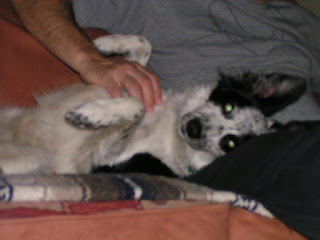
Valerie sent me an email with that subject, and not much content, so I'm left to assume West went on a trip to California, they took this photo, and no one died :)
.jpg)


Wednesday, February 27, 2013
An agility post..
We interrupt your regularly non-scheduled posting for a purely agility post.
For Dog Agility Blog Action Day.. See the other posts here.
I've been helping a friend long distance as she starts to work her rescue dog through some agility in her backyard. He's very fearful and dog reactive, and she's not comfortable taking classes with him, so I've been trying to help.
Agility coaching via youtube is something lots of big-name trainers are offering now, but generally they have a course and materials and instruction. I've just sort of been offering tips as we go, without any set course. This is unideal, but seems to be working!
Here's her first public agility video in Sept 2012 (there were a few before this that were unlisted). I'd suggested she try to be more "fun" to her dog. You can see them both struggling a bit with the single jump. The handler isn't quite helping the dog enough, and the dog is too green to choose the jump on his own.
They've come an AWFULLY long way since then! She's been working on a tricky sequence from Steve's Agility Nerd blog. Specifially, #1-5.
The blind cross at 3 is her current goal, and I don't think she's done any foundation work on blind crosses with her dog. My own dog reads blinds fine, but has some significant jump foundation and I was able to practice them on a slower dog with coaching first. She's just jumped in with both feet.
When I'm helping her out, the first thing I do is watch through the videos all the way. Here are the three videos from the session I'm discussing:
As soon as I got through those, I could tell one of her problems was that she was racing her dog. Even a slow-ish dog with a fast-ish handler is likely to be faster than the handler in a sequence like this. She's using a start line stay to get ahead, but it's not enough.
Here's the second video again:
Here's the third video again:
In this video, we can see the dog's confusion at the lack of reward at the beginning. He stalls out and isn't sure what to do. Once he's reset, he gets his enthusiasm back, and the handler does a pause which brings the dog in. Her change of sides is still very late, but the dog compensates for her.
She's unclear in her side change (though the dog now seems to understand the second jump is the one being rewarded) and she and the dog collide in the third repetition. This encourages the handler to be faster and more deliberate on her fourth attempt. She manages to show the side change before the dog takes off for the jump, and he succeeds!
After this session, I recommended that she work on the second part of the exercise, the Ketschker, first, then come back to the straighter blind cross. She did, and her videos on this can be seen on her channel. After another session, she was putting the whole sequence together quite nicely! She's still a bit hesitant on her Ketschker turn, but hey.. this is a VERY novice team doing quite an advanced sequence!
If you enjoyed this post, leave a comment. I won't fill my blog up with stuff no one wants to read! :)
For Dog Agility Blog Action Day.. See the other posts here.
I've been helping a friend long distance as she starts to work her rescue dog through some agility in her backyard. He's very fearful and dog reactive, and she's not comfortable taking classes with him, so I've been trying to help.
Agility coaching via youtube is something lots of big-name trainers are offering now, but generally they have a course and materials and instruction. I've just sort of been offering tips as we go, without any set course. This is unideal, but seems to be working!
Here's her first public agility video in Sept 2012 (there were a few before this that were unlisted). I'd suggested she try to be more "fun" to her dog. You can see them both struggling a bit with the single jump. The handler isn't quite helping the dog enough, and the dog is too green to choose the jump on his own.
They've come an AWFULLY long way since then! She's been working on a tricky sequence from Steve's Agility Nerd blog. Specifially, #1-5.
The blind cross at 3 is her current goal, and I don't think she's done any foundation work on blind crosses with her dog. My own dog reads blinds fine, but has some significant jump foundation and I was able to practice them on a slower dog with coaching first. She's just jumped in with both feet.
When I'm helping her out, the first thing I do is watch through the videos all the way. Here are the three videos from the session I'm discussing:
As soon as I got through those, I could tell one of her problems was that she was racing her dog. Even a slow-ish dog with a fast-ish handler is likely to be faster than the handler in a sequence like this. She's using a start line stay to get ahead, but it's not enough.
 |
| From Hups Coaching |
At this point, the dog needs to know where he's going so he can decide how to take off for the third jump. The handler is running, but isn't in any position to have cued the dog to take the jump (yes, some handling systems expect the dog to take any jump between the dog and handler. Not this one!) or to change sides. The dog is a good sport and does change sides and come to hand, but goes around the jump.
This problem is repeated in a few more repetitions. These shots show the dog in approximately the same location, but the handler's location changes.
Second attempt:
This problem is repeated in a few more repetitions. These shots show the dog in approximately the same location, but the handler's location changes.
Second attempt:
 |
| From Hups Coaching |
Third attempt (and the best one)
Here's the first video again:

The third attempt is probably the best one as far as the change of arms go, but if you watch the video, the handler's MOTION doesn't cue a change of sides or a turn over the jump at all. So, the dog goes around the jump! :)
Here's the second video again:
In the second video, after a few failed attempts, the handler makes it easier by just asking for the single jump. By this point, the dog really needs a reward, so he's glad to have something he can do!
When she goes back to adding in the next jump, her timing is still way too late. The dog fails to take the jump again until the handler physically positions herself to block the dog and force him to take the jump. This is not a recommended method, though this dog copes well with it.
Here's the third video again:
In this video, we can see the dog's confusion at the lack of reward at the beginning. He stalls out and isn't sure what to do. Once he's reset, he gets his enthusiasm back, and the handler does a pause which brings the dog in. Her change of sides is still very late, but the dog compensates for her.
She's unclear in her side change (though the dog now seems to understand the second jump is the one being rewarded) and she and the dog collide in the third repetition. This encourages the handler to be faster and more deliberate on her fourth attempt. She manages to show the side change before the dog takes off for the jump, and he succeeds!
After this session, I recommended that she work on the second part of the exercise, the Ketschker, first, then come back to the straighter blind cross. She did, and her videos on this can be seen on her channel. After another session, she was putting the whole sequence together quite nicely! She's still a bit hesitant on her Ketschker turn, but hey.. this is a VERY novice team doing quite an advanced sequence!
If you enjoyed this post, leave a comment. I won't fill my blog up with stuff no one wants to read! :)
Tuesday, December 18, 2012
Zisc! Another Westpaw Review
We love Westpaw, mostly because they offer this fantastic one-time replacement guarantee. I can test a toy out with Reiker, if it's not tough enough, they'll give me a free one (usually then an Archie-only toy) and I'm not out anything!
The WestPaw Zisc is a flexible frisbee toy made from Zogoflex rubber. It floats, stays on top of the snow pretty well, and doesn't mind being frozen or out in the hot sun. I expect you could dishwasher it, if you had a dishwasher!
I got my first one from a booth at an Agility trial in 2009 or so. It was blue, and Archie loved it immediately:
He played with it on and off for a couple years. When I brought Reiker home, Reiker played with it a bit, but then I left it with him unattended by mistake and it ended up with a hole in the middle! I was immediately reassured by the guarantee policy, and traded it for an Orange one.
A terrible photo, but Archie shows his glee to have a Zisc again!
"Yipeeeee!"
"It's mine. You can't have it."
"Oh but just throw it? Please?"
It's also good for tugging on:
But mostly for fetching:
And some video of the dogs playing with it:
The WestPaw Zisc is a flexible frisbee toy made from Zogoflex rubber. It floats, stays on top of the snow pretty well, and doesn't mind being frozen or out in the hot sun. I expect you could dishwasher it, if you had a dishwasher!
I got my first one from a booth at an Agility trial in 2009 or so. It was blue, and Archie loved it immediately:
 |
| From Archie |
 |
| From Archie |
 |
| From Archie |
He played with it on and off for a couple years. When I brought Reiker home, Reiker played with it a bit, but then I left it with him unattended by mistake and it ended up with a hole in the middle! I was immediately reassured by the guarantee policy, and traded it for an Orange one.
A terrible photo, but Archie shows his glee to have a Zisc again!
 |
| From Archie |
 |
| From Archie |
 |
| From Archie |
It's also good for tugging on:
 |
| From Archie |
But mostly for fetching:
 |
| From Archie |
And some video of the dogs playing with it:
Sunday, December 9, 2012
Sheela's first Q!!!
This is not a rescue related post. It's just an agility post!
Sheela was my gramma's puppy. She had some agility training up until about 1.5 yrs old, then was hit by a car and lived as a pampered house pet until about age 5. She and I did some more training together, and some competing without much success. She's since gone to live with a new family, where I joke she "Lays on the couch and eats bonbons" all day. Basically, a pampered pet!
But, once in a while, she still gets to come out to trials!
And a Q! Her other run of the day wasn't so spectacular.. Benji, her used-to-be-housemate, was ringside and she went out to visit him!
But we did get a nice photo with the Judge! This could very well be her only Q ever, so... Enjoy the moment, Sheela!

Sheela was my gramma's puppy. She had some agility training up until about 1.5 yrs old, then was hit by a car and lived as a pampered house pet until about age 5. She and I did some more training together, and some competing without much success. She's since gone to live with a new family, where I joke she "Lays on the couch and eats bonbons" all day. Basically, a pampered pet!
But, once in a while, she still gets to come out to trials!
And a Q! Her other run of the day wasn't so spectacular.. Benji, her used-to-be-housemate, was ringside and she went out to visit him!
But we did get a nice photo with the Judge! This could very well be her only Q ever, so... Enjoy the moment, Sheela!

Thursday, December 6, 2012
Sasha/Gentoo Update!

Of course you can. She is kind of like your baby too...
She is a great dog, but needs to be worked with her coming back when called once or twice.. not a billion times... She is VERY social.. which is normal as that is my personality. She rarely barks - only when in her run outside and by herself. Her only other downfall is she will go up to strange dogs in dog park or on off leash walks along river and want to kiss every single dog... She wags her tail and lick, lick, lick..
She runs like the wind. OMG can she run.. She is like a greyhound dog..
She has brought great joy to our family!


Wednesday, December 5, 2012

Tuesday, December 4, 2012

Monday, December 3, 2012
Dog Park Adventures
When I'm staying downtown, I occasionally use the downtown dog park. It's fully fenced with 6+ft chain link, and kept in good repair. In the summer, it has a water tap, and there are a couple benches and a couple trees. It's not huge, but more than enough space to run Reiker stupid, even with a chuckit. There are two entrances, so unless something really strange happens, I can always just squeak out the other entrance when someone comes in.
Reiker only attends the park when it's empty, or when people I know are the only ones there (ie: Gypsy). Today, Reiker and I were playing in the empty park after waiting for a small poodle to leave. A lady drove up, so we headed out. She put her dog in the park and returned to sit in her car (!!) while I put Reik away. As he was getting in the car, she asked if he wanted to play. I said no, but my other dog might. I went to get Arch and dawdled a bit (not planning to take him into a park with an unattended dog!) waiting for the cars to stop zooming past. She finally got out of her car, and I let her go by me to get into the park before I brought him in.
Arch was fine (I knew he would be, obviously) with the dog, and we chatted a bit. She wanted to know how Reiker and Arch got along, and wanted to know who could train her dog for protection. She was thrilled when I explained that she could just use her "speak" training and teach the dog to growl-bark on the cue "Guard". Her .. husband? came later and was also enthusiastic about it.
We stayed for about half an hour, some smaller dogs came and went, Archie mostly played ball.
Then, a man drove up and unloaded a catahoula cross. He had it on a choke collar and was using his hand to 'correct' the dog's face somehow. I wasn't close enough to see if he was hitting the dog or poking it or something else. I quickly determined the dog was on a metal collar and likely to be inhibited, so I leashed Archie and we zoomed out of the park. He only chased one car! I crated him in the car and discovered I didn't have any Five Star business cards, so I just wrote the website on a parking pass, and went back into the park to give it to Tara, the lady with the dog Arch was playing with. She seemed grateful, hopefully she'll contact us!
Overall a positive experience, but how do you explain why it's so risky to let a dog play with a metal-collared dog without offending anyone? I really wish I had an article..

Reiker only attends the park when it's empty, or when people I know are the only ones there (ie: Gypsy). Today, Reiker and I were playing in the empty park after waiting for a small poodle to leave. A lady drove up, so we headed out. She put her dog in the park and returned to sit in her car (!!) while I put Reik away. As he was getting in the car, she asked if he wanted to play. I said no, but my other dog might. I went to get Arch and dawdled a bit (not planning to take him into a park with an unattended dog!) waiting for the cars to stop zooming past. She finally got out of her car, and I let her go by me to get into the park before I brought him in.
Arch was fine (I knew he would be, obviously) with the dog, and we chatted a bit. She wanted to know how Reiker and Arch got along, and wanted to know who could train her dog for protection. She was thrilled when I explained that she could just use her "speak" training and teach the dog to growl-bark on the cue "Guard". Her .. husband? came later and was also enthusiastic about it.
We stayed for about half an hour, some smaller dogs came and went, Archie mostly played ball.
Then, a man drove up and unloaded a catahoula cross. He had it on a choke collar and was using his hand to 'correct' the dog's face somehow. I wasn't close enough to see if he was hitting the dog or poking it or something else. I quickly determined the dog was on a metal collar and likely to be inhibited, so I leashed Archie and we zoomed out of the park. He only chased one car! I crated him in the car and discovered I didn't have any Five Star business cards, so I just wrote the website on a parking pass, and went back into the park to give it to Tara, the lady with the dog Arch was playing with. She seemed grateful, hopefully she'll contact us!
Overall a positive experience, but how do you explain why it's so risky to let a dog play with a metal-collared dog without offending anyone? I really wish I had an article..

A different trip to the same dog park...
Sunday, December 2, 2012
West One Year Update!!

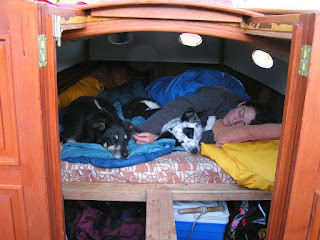
It's now been over a year that West joined us and it's amazing to see how much progress he has made.
Fast learner for good and bad.
He is a super little dog, very special !
He comes and cuddles with us in bed first thing in the morning before we get up.
He and Nina are getting along really well, lots of play time going on.
He's not herding her as much.
We are working on retrieving balls and Frisbees instead.
I take him to my friend's farm to visit with sheep but he could careless.
Too bad considering his very strong herding instincts.


He is doing very well with people generally and will often go forward to say hello.
Still a few things triggering lunching and barking.
People walking on the road with a dog on the leach ???
Strangers (usually men) approaching too fast.
He is doing much better with my husband, they play "come peek" on our walks.
Thanks to my husband who has been very patient with him and all the barking at the beginning.
He has gained 3 lbs (he on raw)


I'm sending a couple of videos and a few pictures of this past year.
The Agility video is from 2 weeks ago, i entered him in 8 runs and he "Q" 4.
We are now in adv. jumpers, (1 more to Masters) and adv. gamblers.
Thanks again for doing all the ground work with him,
he is an awesome dog, i love him dearly.
Valerie


Saturday, December 1, 2012

Friday, November 30, 2012

Thursday, November 22, 2012
Touch

Hand targetting is a great behaviour for all kinds of issues. A dog with a strong hand target can get through difficult, scary or arousing situations by following the owner's lead. Reiker's hand target is very strong and enthusiastic.
Tuesday, November 20, 2012
Hurley!
I happened to 'Like' a page when it was at 399 likes, which made me the 400th "Like". This meant I won a Hurley from Look What I Can Do!
I was initially skeptical of the toy, but it has a one-time guarantee, so if Reiker decided he could shred it up, I'd be able to return it.
I handed it to him to play with while we walked around my sister's place one night, so he'd have something non-rolly on the pavement.

Then I borrowed it for my sister's Labradoodle while I was there for a few days. She loved it.
Finally, Reiker got it back. It's a big hit, doesn't roll out into the road or under things it shouldn't, and he chews on it mightily with no detrimental effects!
I was initially skeptical of the toy, but it has a one-time guarantee, so if Reiker decided he could shred it up, I'd be able to return it.
I handed it to him to play with while we walked around my sister's place one night, so he'd have something non-rolly on the pavement.
Then I borrowed it for my sister's Labradoodle while I was there for a few days. She loved it.
Finally, Reiker got it back. It's a big hit, doesn't roll out into the road or under things it shouldn't, and he chews on it mightily with no detrimental effects!
 |
| From Maligator |
I'm super impressed, and Reiker loves it. We'll be watching for more WestPaw products for sure. Thanks to cTLC, WestPaw and Look What I Can Do for this great product!
Just in case you're coming here from somewhere else and don't know Reiker, he is a very powerful, destructive dog. He has chewed black Kong rubber into bits, destroys heavy Nylabone rubber toys, and even gets through steel crate doors on a regular basis. Will this toy stand up to his chewing forever? Maybe not, but it's done a heck of a job so far!

Sunday, November 18, 2012
Barn practices
Reiker, Archie and I have been attending morning barn practices with Mary and Jill. I've got some video to post, but here's Reiker watching the horses (notice the.. stillness?) before practice.

Saturday, November 17, 2012

Giving up on catching up...
It's been way too long.
I'm living up a mountain, 50k from town. It's beautiful.

Tuesday, November 13, 2012
Another trainer's perspective on the CM show
This is a long response, just to warn you. If you don't want to read a book, just read the next paragraph, then skip down to the end. :)
I have to agree with Anonymous and Denise -- there was almost no content in CM's presentation whatsoever. Certainly, there was little to learn from it, even if one wanted to practice the sort of "training" that he does.
CM had lots of jokes of questionable taste. He also was not clear in his explanations, and some of the diagrams he used were confusing at best. Okay, on to the play by play.
To start, I would like to just say that I find that people are more receptive to what I have to say about CM when I begin my remarks with something like "I think he's quite charismatic and I agree with X and Y." Then I say "But I don't agree with A, B, and C, and here's why." People
seem much more willing to entertain the points I disagree about once I've done the conciliatory thing. Starting out a conversation with "He's abusive and I can't stand him" usually means that people close their ears to everything else that follows.
Having said that, I went to the presentation with the goal of finding something to agree with, something to start my conversation with. In the past, I have been saying that I agree that dogs need exercise, boundaries and leadership, and affection. But I don't agree with what CM says about any of them, so I've found it problematic -- my definitions of reasonable exercise and leadership, for instance, are not the same as his.
I agree that to effectively train or rehabilitate a dog, one should be calm and confident (his new word for assertive). Dogs do pick up on our emotions, and if we are upset, or anxious, or hyper, I think that emotion can transfer down the leash. Confident is something I think of in terms of not being afraid -- being afraid of a dog is not going to be helpful, I don't think.
One of CM's little anecdotes ending with the dog telling CM, "Tell my people that (dog training) is not about me." I agree with that, mostly dog training is about training the people. What I want to teach them though, is different from what he would teach.
He also said that to prevent problems from developing, training needs to start in puppyhood. I agree. However, my methods of prevention differ greatly from his.
He pointed out that when meeting a new (stranger) dog, one should respect the dog's space and give the dog distance. I agree.
He also mentioned that it is not as effective to use verbal communication. I agree; often, dogs are responding to our body language and not our words.
One of his points was that the mealtime ritual can represent excitement to the dog if we set it up that way by riling up the dog and creating a situation where we ramp up their excitement. I think we can do this inadvertently.
Dogs need rules, boundaries, limitations. I agree.
CM also talked about the biggest challenge being to help clients not focus on the past or the future. (I took this to mean, if the dog always barks and lunges when he sees another dog, we tend to "live in the past" and then "anticipate" and "project into the future" (my restatements of what I got, not exactly what he said). Therefore, we are tense and anxious, and that translates to the dog. Agreed.
Dogs live in the present. Probably true, up to a point. But don't tell me that my dog doesn't remember what happens when the nail clippers come out, or that he doesn't remember that a dog lives in the house on the corner. And don't try to tell me that he doesn't remember bad or stressful experiences -- I think we've all seen that our dogs do have memories of the past.
Emotion leads to energy/pheromones, which leads to changes in body language, which leads to changes in behaviour. Okay, I can buy that, too. When I get tense and tighten up on the lead (emotion and body language), this leads to a change in my dog's behaviour. He senses my tension and goes on alert.
One thing that he repeated several times is that he drew parallels between leadership of dogs and his leadership to his son. I find that this is a bit contrary to his also repeated opinion that we should not treat dogs like children, so I was a bit confused. I often liken leadership to the
parental role, but it wasn't clear to me what CM was saying, because he seemed to say yes and no at different times.
Dogs today don't have jobs. Mostly true. Dogs with jobs, even if it's just scavenging food from a tricky treat ball, are generally better off than dogs that don't have anything to do. That's why we say to do a bit of training every day, to give your dog mental exercise and "a job" to do.
Dogs learn by steps. Agreed -- we have to break things into small pieces to teach them to the dog, just like we have to do when we're teaching another person.
Communication creates partnership. Yep, I agree with this, too. I just communicate differently, and I suggest that his type of communication doesn't create partnership, but rather fear and intimidation.
Dogs communicate all the time, we just don't listen. I've said much the same thing to my puppy classes. Dogs have to shout when humans don't pay attention -- very true. That's why dogs escalate to bites, because people don't see their communications prior to the bite (or have punished out those communications).
Use your tools before a dog's behaviour problem escalates / work at a 2 and not a 10. I would suggest that working at an even lower level than a 2 is more effective -- working under threshold is MUCH more effective than working at threshold or over.
So there were points I agreed with, at least sort of. Again, I agree with the principles, but not what he does about them in most cases.
There were also many disturbing things said and done. The demo dogs were all stressed out. Some of that is no doubt due to the crowd, the noise, the lights, etc. But as CM interacted with them, the calming signals were flying like crazy, and one dog almost hyperventilated, he was so stressed. Every single dog with the possible exception of the two puppies was clearly stressed out, if you know what you're looking at when you see a dog licking it's lips, panting, yawning, licking, blinking, scratching, putting ears back, and repeating them all over and over again.
He talked about the dog needing to learn the rules of the pack, and that a dog's first responsibility is to the pack before itself. Dogs DO need to learn the rules of the family/household, but I think most dogs aren't thinking about the collective before themselves. I think they're thinking about what they want and how to get it.
He had a strange segment about separation anxiety -- my notes are that dogs need to learn detachment. I'm not quite sure what he means by that.
There was a "wolf hybrid" on stage, and CM and the owner kept marvelling about how "calm" the dog was. Only to the uneducated eye - the calming signals were clearly communicating that the dog was NOT calm.
He used the slip lead around the top of the dog's throat, like Anonymous mentioned. I noted that each time he used it on a demo dog, there was almost constant tension on the lead (so that the dog would be fully aware that they were in jeopardy of the "corrections" or the jerks on the leash), and then he did some subtle jerks and kicks. Like Anonymous said, he's so good at them, it's hard to notice unless you're watching for them. Most of the audience was not watching and did not see it.
With the dog that came on stage pulling his owner around the stage, my note is "the dog is still pulling, it's just that the collar is pressing on the sensitive spot", and then CM did his jerks and kicks and the dog started to suppress behaviour to try to avoid the jerks and the kicks. Everyone around us clapped and commented about how wonderful it was that CM could do
that so fast. I could do the same thing with a handful of treats, and not risk hurting the dog or damaging my relationship with him. And I'd have focus, rather than the almost desperate "please don't notice me" that the dog was projecting.
There was also a dog that was scared of clapping. So the audience clapped repeatedly. That poor dog. And when she showed her fear, the audience laughed. It was alarming and appalling. He kept getting the audience to clap, and the poor dog started to shut down.
My note here is "the reason it works so fast is that it uses suppression of behaviour and aversives". Truth. Not because the dog is learning what TO do, but because the dog is learning that doing X is dangerous.
He worked with a dog with toy drive -- sure, it needed an off switch, but he continued to "correct" her every time she noticed or moved toward the ball. So the dog started ignoring the ball -- a quick learner for sure. His comment was that she was in a relaxed state. Her body language showed anything but that -- panting, lip licking, ears back -- my note is "totally
stressed dog".
At one point, he talked about why he kicks the dogs instead of doing the "sssssttt" and poking it in the neck. He said he does it because the dog's neck is numb. I don't think I need to say why I find that disturbing.
He also said he wants dogs to surrender. I would rather have my dog eager to learn, wanting to play the game, rather than shutting down.
He talked about how he's only ever seen a few dogs he would call truly aggressive. One of them is Holly, a yellow lab. You may have seen the video -- he gets bitten. He commented that "he didn't see it coming" -- the video he showed was nicely edited, so that all the warning signs weren't shown. If you've seen the video, you could see that the dog was indeed shouting -- the fact that he "didn't see it coming" is a true reflection of his knowledge.
There was also a demo dog that was an explosive detection dog. It was rewarded by a toy, and the handler even said, "it's all about the toy" for this dog. Obviously this dog was trained using positive reinforcement! It was rather misleading, since that dog was clearly not trained using his methods.
In short, I found that his performance reinforced my beliefs about his methods and his lack of education and knowledge about dog behaviour, when it wasn't full of tasteless jokes and incomprehensible "explanations". Although it looks like I found plenty to agree with, I have to say again that although I might agree with the principles of what he says, I definitely do NOT agree with what he does about them.
Even if a person was a CM fan, I think it would have been a waste of money. I am glad I went, because when people ask me about it, I can now speak knowledgeably about his show and my opinion about what he says. It wasn't a pleasant experience, by any stretch, but it could also have been much worse.
All in all, for the average pet owner, I think that the show was just that -- a performance by CM and a commercial for his new show and his son's new show (God help us, Puppy Whisperer). There was very little content, and what there was to see just reinforced how abusive his methods are. Most of the people there didn't even see the things that the dogs were saying, and just accepted at face value that CM is "magical". Only to the uneducated eye, is what I have to say.
Rant over. Thanks for reading, if anyone did! :)
I have to agree with Anonymous and Denise -- there was almost no content in CM's presentation whatsoever. Certainly, there was little to learn from it, even if one wanted to practice the sort of "training" that he does.
CM had lots of jokes of questionable taste. He also was not clear in his explanations, and some of the diagrams he used were confusing at best. Okay, on to the play by play.
To start, I would like to just say that I find that people are more receptive to what I have to say about CM when I begin my remarks with something like "I think he's quite charismatic and I agree with X and Y." Then I say "But I don't agree with A, B, and C, and here's why." People
seem much more willing to entertain the points I disagree about once I've done the conciliatory thing. Starting out a conversation with "He's abusive and I can't stand him" usually means that people close their ears to everything else that follows.
Having said that, I went to the presentation with the goal of finding something to agree with, something to start my conversation with. In the past, I have been saying that I agree that dogs need exercise, boundaries and leadership, and affection. But I don't agree with what CM says about any of them, so I've found it problematic -- my definitions of reasonable exercise and leadership, for instance, are not the same as his.
I agree that to effectively train or rehabilitate a dog, one should be calm and confident (his new word for assertive). Dogs do pick up on our emotions, and if we are upset, or anxious, or hyper, I think that emotion can transfer down the leash. Confident is something I think of in terms of not being afraid -- being afraid of a dog is not going to be helpful, I don't think.
One of CM's little anecdotes ending with the dog telling CM, "Tell my people that (dog training) is not about me." I agree with that, mostly dog training is about training the people. What I want to teach them though, is different from what he would teach.
He also said that to prevent problems from developing, training needs to start in puppyhood. I agree. However, my methods of prevention differ greatly from his.
He pointed out that when meeting a new (stranger) dog, one should respect the dog's space and give the dog distance. I agree.
He also mentioned that it is not as effective to use verbal communication. I agree; often, dogs are responding to our body language and not our words.
One of his points was that the mealtime ritual can represent excitement to the dog if we set it up that way by riling up the dog and creating a situation where we ramp up their excitement. I think we can do this inadvertently.
Dogs need rules, boundaries, limitations. I agree.
CM also talked about the biggest challenge being to help clients not focus on the past or the future. (I took this to mean, if the dog always barks and lunges when he sees another dog, we tend to "live in the past" and then "anticipate" and "project into the future" (my restatements of what I got, not exactly what he said). Therefore, we are tense and anxious, and that translates to the dog. Agreed.
Dogs live in the present. Probably true, up to a point. But don't tell me that my dog doesn't remember what happens when the nail clippers come out, or that he doesn't remember that a dog lives in the house on the corner. And don't try to tell me that he doesn't remember bad or stressful experiences -- I think we've all seen that our dogs do have memories of the past.
Emotion leads to energy/pheromones, which leads to changes in body language, which leads to changes in behaviour. Okay, I can buy that, too. When I get tense and tighten up on the lead (emotion and body language), this leads to a change in my dog's behaviour. He senses my tension and goes on alert.
One thing that he repeated several times is that he drew parallels between leadership of dogs and his leadership to his son. I find that this is a bit contrary to his also repeated opinion that we should not treat dogs like children, so I was a bit confused. I often liken leadership to the
parental role, but it wasn't clear to me what CM was saying, because he seemed to say yes and no at different times.
Dogs today don't have jobs. Mostly true. Dogs with jobs, even if it's just scavenging food from a tricky treat ball, are generally better off than dogs that don't have anything to do. That's why we say to do a bit of training every day, to give your dog mental exercise and "a job" to do.
Dogs learn by steps. Agreed -- we have to break things into small pieces to teach them to the dog, just like we have to do when we're teaching another person.
Communication creates partnership. Yep, I agree with this, too. I just communicate differently, and I suggest that his type of communication doesn't create partnership, but rather fear and intimidation.
Dogs communicate all the time, we just don't listen. I've said much the same thing to my puppy classes. Dogs have to shout when humans don't pay attention -- very true. That's why dogs escalate to bites, because people don't see their communications prior to the bite (or have punished out those communications).
Use your tools before a dog's behaviour problem escalates / work at a 2 and not a 10. I would suggest that working at an even lower level than a 2 is more effective -- working under threshold is MUCH more effective than working at threshold or over.
So there were points I agreed with, at least sort of. Again, I agree with the principles, but not what he does about them in most cases.
There were also many disturbing things said and done. The demo dogs were all stressed out. Some of that is no doubt due to the crowd, the noise, the lights, etc. But as CM interacted with them, the calming signals were flying like crazy, and one dog almost hyperventilated, he was so stressed. Every single dog with the possible exception of the two puppies was clearly stressed out, if you know what you're looking at when you see a dog licking it's lips, panting, yawning, licking, blinking, scratching, putting ears back, and repeating them all over and over again.
He talked about the dog needing to learn the rules of the pack, and that a dog's first responsibility is to the pack before itself. Dogs DO need to learn the rules of the family/household, but I think most dogs aren't thinking about the collective before themselves. I think they're thinking about what they want and how to get it.
He had a strange segment about separation anxiety -- my notes are that dogs need to learn detachment. I'm not quite sure what he means by that.
There was a "wolf hybrid" on stage, and CM and the owner kept marvelling about how "calm" the dog was. Only to the uneducated eye - the calming signals were clearly communicating that the dog was NOT calm.
He used the slip lead around the top of the dog's throat, like Anonymous mentioned. I noted that each time he used it on a demo dog, there was almost constant tension on the lead (so that the dog would be fully aware that they were in jeopardy of the "corrections" or the jerks on the leash), and then he did some subtle jerks and kicks. Like Anonymous said, he's so good at them, it's hard to notice unless you're watching for them. Most of the audience was not watching and did not see it.
With the dog that came on stage pulling his owner around the stage, my note is "the dog is still pulling, it's just that the collar is pressing on the sensitive spot", and then CM did his jerks and kicks and the dog started to suppress behaviour to try to avoid the jerks and the kicks. Everyone around us clapped and commented about how wonderful it was that CM could do
that so fast. I could do the same thing with a handful of treats, and not risk hurting the dog or damaging my relationship with him. And I'd have focus, rather than the almost desperate "please don't notice me" that the dog was projecting.
There was also a dog that was scared of clapping. So the audience clapped repeatedly. That poor dog. And when she showed her fear, the audience laughed. It was alarming and appalling. He kept getting the audience to clap, and the poor dog started to shut down.
My note here is "the reason it works so fast is that it uses suppression of behaviour and aversives". Truth. Not because the dog is learning what TO do, but because the dog is learning that doing X is dangerous.
He worked with a dog with toy drive -- sure, it needed an off switch, but he continued to "correct" her every time she noticed or moved toward the ball. So the dog started ignoring the ball -- a quick learner for sure. His comment was that she was in a relaxed state. Her body language showed anything but that -- panting, lip licking, ears back -- my note is "totally
stressed dog".
At one point, he talked about why he kicks the dogs instead of doing the "sssssttt" and poking it in the neck. He said he does it because the dog's neck is numb. I don't think I need to say why I find that disturbing.
He also said he wants dogs to surrender. I would rather have my dog eager to learn, wanting to play the game, rather than shutting down.
He talked about how he's only ever seen a few dogs he would call truly aggressive. One of them is Holly, a yellow lab. You may have seen the video -- he gets bitten. He commented that "he didn't see it coming" -- the video he showed was nicely edited, so that all the warning signs weren't shown. If you've seen the video, you could see that the dog was indeed shouting -- the fact that he "didn't see it coming" is a true reflection of his knowledge.
There was also a demo dog that was an explosive detection dog. It was rewarded by a toy, and the handler even said, "it's all about the toy" for this dog. Obviously this dog was trained using positive reinforcement! It was rather misleading, since that dog was clearly not trained using his methods.
In short, I found that his performance reinforced my beliefs about his methods and his lack of education and knowledge about dog behaviour, when it wasn't full of tasteless jokes and incomprehensible "explanations". Although it looks like I found plenty to agree with, I have to say again that although I might agree with the principles of what he says, I definitely do NOT agree with what he does about them.
Even if a person was a CM fan, I think it would have been a waste of money. I am glad I went, because when people ask me about it, I can now speak knowledgeably about his show and my opinion about what he says. It wasn't a pleasant experience, by any stretch, but it could also have been much worse.
All in all, for the average pet owner, I think that the show was just that -- a performance by CM and a commercial for his new show and his son's new show (God help us, Puppy Whisperer). There was very little content, and what there was to see just reinforced how abusive his methods are. Most of the people there didn't even see the things that the dogs were saying, and just accepted at face value that CM is "magical". Only to the uneducated eye, is what I have to say.
Rant over. Thanks for reading, if anyone did! :)
A trainer's perspective on the CM show
Hi all,
Here are my thoughts on Cesar's show I attended Friday night.
First, I have to say that I've been to MANY, MANY talks, seminars, conferences and seen MANY, MANY presenters (dozens and dozens). Regardless of whether I like their message or not, the speakers I consider good at their jobs always present their points in a clear and concise way, followed by a the body of the presentation that might include facts, research, opinion, videos, demos; and finally ending with me (the listener) having an understanding of what their point was and maybe how to implement it.
On the above point, for me, Cesar's show was among the worse I've seen. Many of the points he was making left me thinking "HUH?" I honestly did not "get" the point. Now I understand there was an ESL issue, but he could have gotten around that with good videos, etc.
For example, in the first segment he was talking about leadership and especially in the first 180 days of a dog's life. (For some reason, he feels 180 days is a very important date. In my experience, it's pretty hard to tell people exactly when "puppy" behaviors will end). Anyway, he did mention 180 days a few times. Then the first 2 dogs came out, a cattle dog pup and a young lab. I assumed they were both under "180 days" but it wasn't exactly explained. Anyway, the 2 puppies greeted each other rather nicely, then proceeded to investigate the stage. Cesar was talking to the audience and as he was talking, he sidled over to the lab, who completely ignored him, not surprisingly. Cesar said, "see, I am not interesting to this puppy". Then a helper brought out a bowl of food and handed it to Cesar who went over to the lab pup. With Cesar holding the food bowl, the puppy followed him around the stage. He gave the food to the lab the. The helper brought out another bowl of food and it was repeated with the cattle dog puppy. He asked the audience if they understood his point, people clapped, the puppies were taken away and I thought "HUH?" I really can't tell you what his point was. Maybe the others who attended could enlighten me.
For the most part, the 6 or 7 dogs who went on stage were not mistreated. Exception being a pitty/lab cross who was brought on stage by his dad to demonstrate what a bad dog he was, pulling dad all over the place (which he did perfectly). Cesar went on and on about how the owner must be "calm" in order to have a "calm" dog. He then proceeded to use a thin leather leash as a slip choke collar (noose style). Cesar placed it very high on the dog's neck, just under the jawline and, allowing only about 1 foot of leash, proceeded to walk around the stage with the dog at his side. Miraculously, the dog did not pull at all (pretty hard when there's no leash to pull). There were 2 large screens and I was watching Cesar's leash hand closely. In the 2 or 3 minutes Cesar had the dog, the dog received approx 20 chokes, and 2 kicks. Cesar is so expert at doing this without it looking like anything. His leash hand just subtly quickly opened and closed, and each time it closed, the dog got a correction. The dog did not leave his side. He asked the owner, "So, why is your dog so good with me?" and after a few prompts, the man said "because you are calm?". Audience claps, Cesar hands the dog back to owner and they leave.
My feelings on this - well, he achieved his objective of having the dog not pull and maybe if the owner only has to do this one or two times, it might be worth it. But Cesar supplied no insight as to how to implement this method or how long it'll take to fix the problem. (Maybe one has to buy his book to find out). Sadly, I saw a dog that came out rather out of control, but very happy and confident. When he left, his respiratory rate was through the ceiling (truly hyperventilating) and he was not a happy puppy. The saddest thing of all though, was that the vast majority of attendants only saw a dog who was brought under control by Cesar's calmness.
There are many other examples but this email would end up being 20 pages long so I'll spare you.
I ran into a lady who attended my friend's classes a couple of years ago with her goldendoodle. Her husband is a police K9 handler. She said they were very underwhelmed by the whole thing.
I look forward to input from others as well.
Anonymous
Here are my thoughts on Cesar's show I attended Friday night.
First, I have to say that I've been to MANY, MANY talks, seminars, conferences and seen MANY, MANY presenters (dozens and dozens). Regardless of whether I like their message or not, the speakers I consider good at their jobs always present their points in a clear and concise way, followed by a the body of the presentation that might include facts, research, opinion, videos, demos; and finally ending with me (the listener) having an understanding of what their point was and maybe how to implement it.
On the above point, for me, Cesar's show was among the worse I've seen. Many of the points he was making left me thinking "HUH?" I honestly did not "get" the point. Now I understand there was an ESL issue, but he could have gotten around that with good videos, etc.
For example, in the first segment he was talking about leadership and especially in the first 180 days of a dog's life. (For some reason, he feels 180 days is a very important date. In my experience, it's pretty hard to tell people exactly when "puppy" behaviors will end). Anyway, he did mention 180 days a few times. Then the first 2 dogs came out, a cattle dog pup and a young lab. I assumed they were both under "180 days" but it wasn't exactly explained. Anyway, the 2 puppies greeted each other rather nicely, then proceeded to investigate the stage. Cesar was talking to the audience and as he was talking, he sidled over to the lab, who completely ignored him, not surprisingly. Cesar said, "see, I am not interesting to this puppy". Then a helper brought out a bowl of food and handed it to Cesar who went over to the lab pup. With Cesar holding the food bowl, the puppy followed him around the stage. He gave the food to the lab the. The helper brought out another bowl of food and it was repeated with the cattle dog puppy. He asked the audience if they understood his point, people clapped, the puppies were taken away and I thought "HUH?" I really can't tell you what his point was. Maybe the others who attended could enlighten me.
For the most part, the 6 or 7 dogs who went on stage were not mistreated. Exception being a pitty/lab cross who was brought on stage by his dad to demonstrate what a bad dog he was, pulling dad all over the place (which he did perfectly). Cesar went on and on about how the owner must be "calm" in order to have a "calm" dog. He then proceeded to use a thin leather leash as a slip choke collar (noose style). Cesar placed it very high on the dog's neck, just under the jawline and, allowing only about 1 foot of leash, proceeded to walk around the stage with the dog at his side. Miraculously, the dog did not pull at all (pretty hard when there's no leash to pull). There were 2 large screens and I was watching Cesar's leash hand closely. In the 2 or 3 minutes Cesar had the dog, the dog received approx 20 chokes, and 2 kicks. Cesar is so expert at doing this without it looking like anything. His leash hand just subtly quickly opened and closed, and each time it closed, the dog got a correction. The dog did not leave his side. He asked the owner, "So, why is your dog so good with me?" and after a few prompts, the man said "because you are calm?". Audience claps, Cesar hands the dog back to owner and they leave.
My feelings on this - well, he achieved his objective of having the dog not pull and maybe if the owner only has to do this one or two times, it might be worth it. But Cesar supplied no insight as to how to implement this method or how long it'll take to fix the problem. (Maybe one has to buy his book to find out). Sadly, I saw a dog that came out rather out of control, but very happy and confident. When he left, his respiratory rate was through the ceiling (truly hyperventilating) and he was not a happy puppy. The saddest thing of all though, was that the vast majority of attendants only saw a dog who was brought under control by Cesar's calmness.
There are many other examples but this email would end up being 20 pages long so I'll spare you.
I ran into a lady who attended my friend's classes a couple of years ago with her goldendoodle. Her husband is a police K9 handler. She said they were very underwhelmed by the whole thing.
I look forward to input from others as well.
Anonymous
Subscribe to:
Posts (Atom)